What is it like having a baby in Norway?
An experience I’ll cherish forever
Recently my family welcomed a baby girl into our world, and we could not be happier. While we were excited to learn of the pregnancy, my thoughts immediately jumped to, “what is it like being pregnant in a new country and delivering a baby so far from home?” Now curious friends and family have asked what it was like to have a baby in Norway. While the general process and care was similar to my experience in the United States, there were some differences.
This was not my first pregnancy, but being in a country where English is not the first language and the healthcare system is quite different from what I’m used to felt daunting. I wasn’t even sure who to call to set up my initial appointment.
A Midwife is your main point-of-contact
After some digging on our town’s website, I learned that there are midwife services at the local helsestasjon (doctor’s office), and I reached out to one of them. She let me know that I would see her for all of my pregnancy appointments and got my first appointment scheduled. This appointment happens sometime between 6 and 11 weeks. No ultrasound was performed to confirm the pregnancy at this point, but she did want to get a thorough medical history and provided me with some education. Some handouts were available in English, and others I had to translate from Norwegian. I was happy to have the important information given to me in English. This was a resource on what to expect throughout the entire pregnancy process, from week 6 until delivery, in Norway.
The cadence of appointments was somewhat similar to what I experienced in the United States. I saw a midwife, either at my local helsestasjon or the hospital for an ultrasound, about every 4 to 6 weeks. This changed to weekly in the last month of pregnancy.
Labs, Ultrasounds, & Routine Tests
In the Norwegian health system overall, labs and tests are only completed if deemed necessary; therefore, this varied slightly from what I experienced in the US. I had an ultrasound performed at 13 weeks to confirm the pregnancy’s viability and a second at 20 weeks for the anatomy scan. These were the only times we got to see our baby. This was slightly different from what we experienced in the US. Although I did have a minor complication with my son that required a few extra scans, so maybe this cadence is common in the US as well. I do know more ultrasounds will be performed in Norway if necessary or when extra caution is needed.
All of the bloodwork that I had done in Norway was the same as what I had done in the US. However, it is my understanding that testing for gestational diabetes is a standard of care in the US, but this is not the case in Norway. I asked my midwife about being tested for gestational diabetes, and she looked at me confused, asking, “do you have any risk factors I am unaware of or are you feeling any symptoms related to diabetes?” When I told her I did not, she simply stated that it was not necessary to run that test then. This may not be of interest to many pregnant people, but as a diabetes educator I had to ask the question.
There were no checks to determine if my body was preparing for labor towards the end of my pregnancy. There was very much a feeling of “your body knows what to do and it will let us know when it’s ready.” We never discussed a set birth plan, but I was made aware that there were two sides to the delivery floor at the hospital, one for women who wished to deliver naturally and another for women who wanted or needed medical interventions. I was allowed to start on the non-medical intervention side of the floor and switch to the medical intervention side if I decided that was necessary while in labor.
Hospitals are centralized
Hospitals are located in cities and areas with higher populations, meaning if you live in a more rural area or a small town, you will likely need to drive a distance to the hospital. Our closest hospital with a labor and delivery ward is a 2 to 3 hours drive away depending on the car ferry schedule. This became my biggest stressor during pregnancy. I was very fearful that I would have a baby in the car on the side of the road, during a snowstorm. Spoiler alert, that did not happen, but it did feel like a long drive to the hospital. That drive occurred just before midnight, during a snowstorm. Along the route we saw the Aurora Borealis, followed by white out snow conditions, and the events were capped off by a very large moose crossing the road in front of us. However, we did make it safely to the hospital and my pain was not too bad.

Maternity Wards
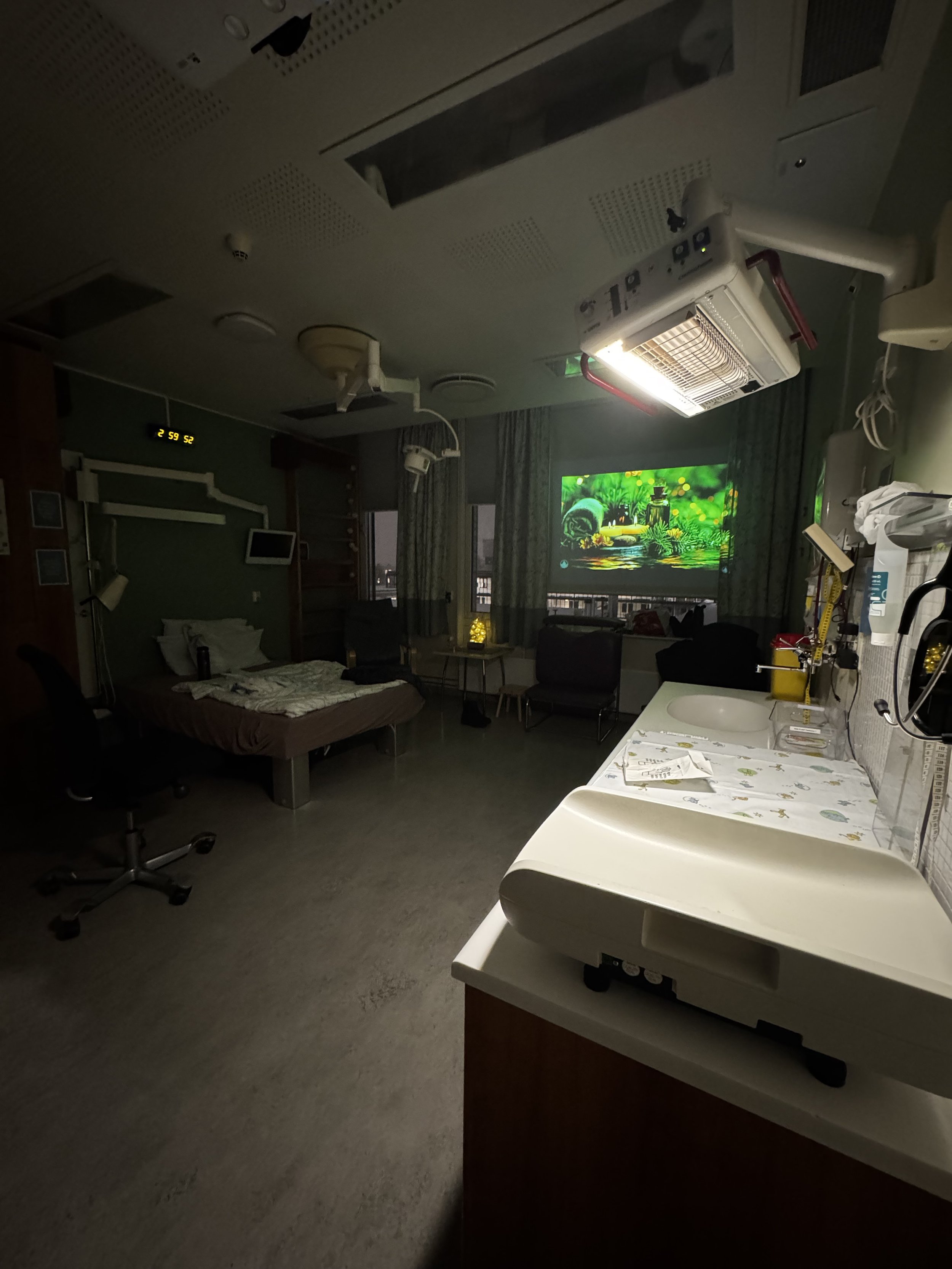
As I mentioned above, the maternity floor has two sides, a non-medical intervention side and a medical intervention side. Both sides are led by midwives and doctors are available if needed. My visit started on the non-medical side of the floor because my water had broken naturally and there was no need for medical interventions at the time. Upon entering the hospital, we were met by a midwife who had a very calming tone and brought us to our room. The room was dimly lit with a queen sized bed, soft relaxing music playing, a nature scene projected on the wall, fake candles glowing, and a variety of pain relief options available, including a large tub in a private bathroom. I immediately felt relaxed when I walked into the room. It would have been a wonderful place to deliver a baby.
Unfortunately my body had other plans, and I had to move to the medical intervention side of the floor. Lucky for you, I can now share the differences I experienced between the two sides of the floor. The medical intervention side was more similar to a traditional hospital setting like what we are familiar with in the US. The bed was a traditional hospital bed and the setting was not quite as serene. However, there was still only one midwife in the room with me, and she kept the atmosphere as calm as possible throughout the entire process.
The midwife rarely left my room. This was different than in the US. She maybe stepped out to use the restroom or eat something, but otherwise, she was with me throughout the entirety of my labor. It was truly one-on-one care. Non-medical pain management options were still available for me to utilize, but if I wanted something more medical, like an epidural, those interventions were available to me as well. The midwife did not question any of my requests either. She would confirm that I wanted an intervention before proceeding, but she did not make me feel as though she was passing judgement on how I chose to proceed with my labor and delivery experience.
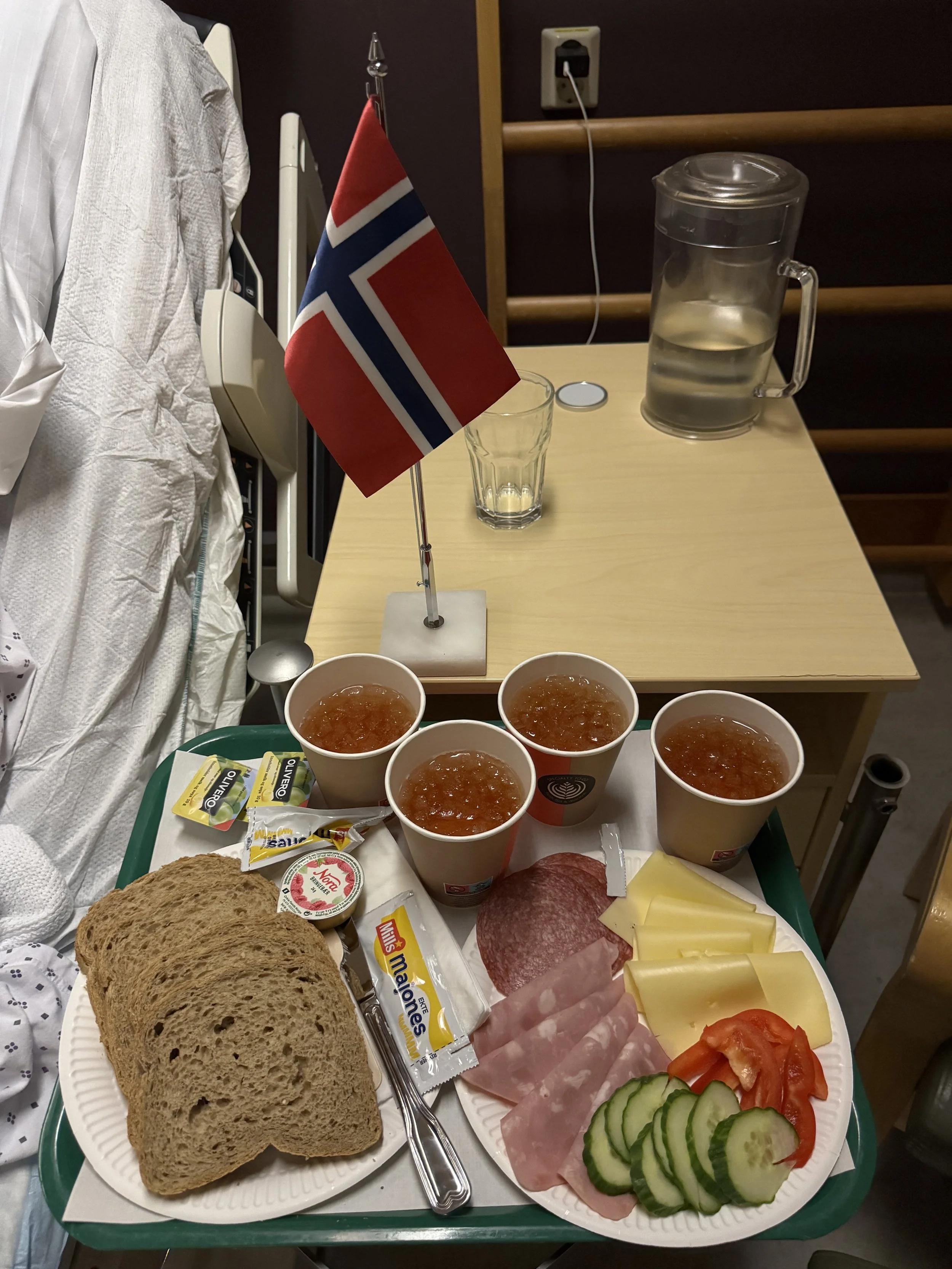
After delivery, the steps were pretty similar as well. My baby and I received the same medical care in Norway as I did in the states, and we were able to spend some alone time as a family in the room before switching to a recovery room. My favorite part of the immediate aftercare was our first meal together. In Norway they serve a tray of deli meats, cheese, bread, butter, jams, and juice accompanied by a little Norwegian flag as decoration.
Patient Hotel
After the meal and golden hour of time together as a family is complete, you are moved to a recovery room. At our hospital this meant we moved over to the patient hotel. Yes, an actual hotel at the hospital. In fact, my parents and son stayed on a lower floor while we were in the hospital so they were close and able to meet the baby when she arrived.
One of the floors of the hotel is dedicated to the maternity ward. The floor is staffed with midwives and a pediatrician visits most days. The floor and rooms still resemble a hospital more than a hotel, but the environment is very quiet and relaxing. This was one of the biggest differences I felt between delivery in the US and delivering in Norway. Because we had a relatively uncomplicated delivery, our vital checks were held to a minimum and done only at times when we were awake. Our rest and sleep were the priority and midwives did not disturb us when rest was occurring. I did have to be proactive about getting my pain medication, but they were happy to provide it on an appropriate regimen when I asked.
Meals were not served in our room and the pediatrician did not come to the room to perform their examination of our baby. This meant I had to get out of bed and move about the hotel soon after delivery. At the time I complained about having to move around so much, but I do think it was good for my body to move and a benefit of having to eat in the hotel dining room. The meals consisted of traditional Norwegian cuisine and a lot of deli meat, cheese, and bread. I was ready for some pasta by the time we got back home. You are allowed 1 to 3 days of stay at the hotel after delivery, of course this can change due to individual needs.
Follow-Up Care
Another major difference is the follow-up care in Norway. The cadence of the visits are the same. We had an appointment for our baby within the first three days of returning home, then two weeks later, and again at the six weeks mark for both of us. However, the three day old and two weeks old visits occurred at our house. The midwife we saw during pregnancy came to our home to do the physical exams and first follow-ups for our baby. This makes the transition home so much easier. There was no stress of getting ready and out the door, in the middle of winter, for a doctor’s appointment. I really enjoyed this aspect of follow-up care.
Cost
By far the biggest difference between having a baby in Norway and having a baby in the United States was the cost. As I’m sure we all know, having a baby in the US is not cheap. It is something we hopefully get to plan for and have insurance to help cover the costs. It ends up being somewhere in the thousands of dollars. In Norway, you pay nearly nothing throughout the entire pregnancy. There were no follow-up bills for our pregnancy appointments or delivery and medical treatments at the hospital. Our immediate expenses included parking at the hospital, my husband’s stay at the hospital and hotel (500 NOK per day, about 50 USD per day), extra food, and our ferry ride back home. It was truly an eye opening experience and felt remarkable to have such little expense associated with having our second child. However, it is important to note that there are very high taxes in Norway, both income taxes and taxes for everyday goods and payments. The money Norway collects in taxes goes towards many government funded programs, like child care which encompasses having a baby. So while we technically paid for the birth and pregnancy visits, there was no money exchanged at the time of care, and we did not have to set money aside to have our baby.
I hope you have learned a little more about what it’s like having a child outside of the US. If you are expecting a baby abroad or thinking it may be a possibility for you, I am here to say it was an amazing experience and one I will treasure forever.